Too much at once
Cognitive Load Theory
We can only juggle a few new things at once, so cut the clutter and give people one thing at a time

What it says, in plain language
The idea in one sentence: we can only juggle about four new things in our heads at once, so when teaching asks for more than that, people learn less. Some of the effort belongs to the topic. The rest is clutter, and the clutter is the part you can cut.
You’ve seen this already
Think about driving somewhere new in heavy rain. The sat nav is talking, the wipers are going, and you’re looking for a turning. You turn the radio off. You haven’t become less clever. Your head is full, and you’re making room for what matters.
On your daily commute, you can chat and listen to the news and still not miss your turning. You know the route so well it hardly takes up any room.
That’s the whole idea. The part of memory we use to think about new things (often called working memory) is small. Things we know well take up little of it. New things fill it fast.
Why it matters for your teaching
Picture a new healthcare assistant’s first shift. In the first hour they’re told the door codes, the fire exits, how to log in, who to call for what, the falls policy and how the observations (obs) machine works. By lunchtime they remember the door code and not much else. They were listening. It was just too much at once.
It helps to split the effort into two kinds:
| What it is | What you can do | |
|---|---|---|
| Effort that belongs to the topic | Some things are hard because lots of parts connect, like a drug calculation | You can’t remove it, but you can break it into steps and build up |
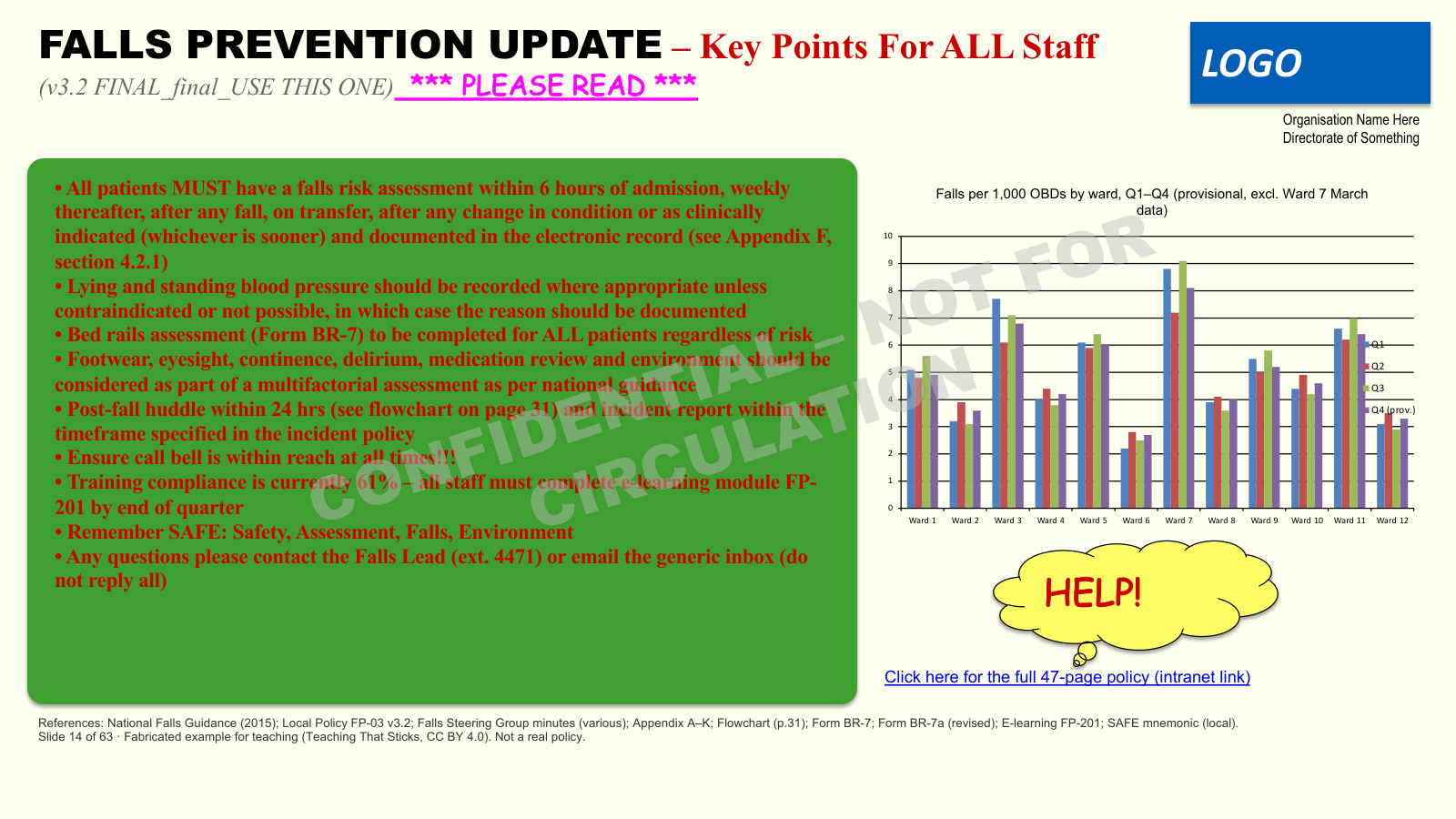
| Effort from clutter | Effort caused by how it’s taught: a crowded slide, a long email, a noisy corridor, a logo in every corner | Cut it |
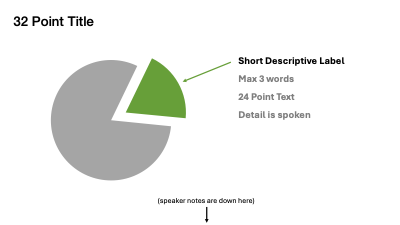
The slides below show the difference. The first is crammed with clutter. The second keeps one chart and a few words, and the speaker says the rest.
What counts as “too much” depends on who’s learning. A step-by-step guide that helps a new starter can slow down someone who’s done the task a hundred times. So start with what these people need to do differently. It tells you what to keep, what to cut and what can wait.
Try this
- Cut anything that isn’t doing a job. Decoration, logos, long sentences and showy animations all cost attention. A short video that shows how a procedure really unfolds is different, and often helps.
- Give one idea at a time. Let it land, let people use it, then add the next. At a huddle, that might mean one change today, not five.
- Put a few key words on the slide and say the rest. Reading a text-only slide aloud does little harm, but people tend to read ahead of you. If the slide has a picture too, the written words compete with it for people’s eyes. See dual coding.
- Show one worked example before people try it alone. For a new starter, watching you talk through one real example can leave more room to learn than struggling alone.
How sure are we?
The core idea has strong support. Many lab experiments show that people learn less when they must juggle too much, and that cutting clutter helps. Most used students learning maths, science or short on-screen lessons, tested soon afterwards. Far fewer have been done in hospitals, care homes or on shift, so we’re borrowing the idea for your setting, not proving it there.
The two kinds of effort are a rule of thumb. Researchers argue about a third kind (“germane” load), so we leave it out. “About four” is an estimate, not a fixed limit.
One common misreading: this doesn’t mean “make it easy”. Some effort is how people learn. The aim is to spend their effort on the topic, not on the clutter.
Where it comes from
John Sweller, an educational psychologist in Australia, set out cognitive load theory in 1988. He wanted to know why solving lots of practice problems can teach less than you’d expect, and why studying worked examples often helps more. In 1956 the psychologist George A. Miller (not the Miller of Miller’s pyramid) had suggested we hold about seven things in mind at once; in 2001 Nelson Cowan reviewed the evidence and put it nearer four. Sweller and others, including Richard Mayer, later turned the idea into practical design advice.
What this looks like in practice
The evidence